How Much CCTV Storage Do You Really Need? Formula, Examples and Table
How many days a CCTV recorder keeps depends on one number most people never check: the cameras' bitrate. This guide gives a simple formula you can work out on a phone calculator, worked examples, a drive-size table and the reasons real retention is usually a little shorter.
Why bitrate, not resolution, decides how much space footage uses
The formula: total Mbps × 10.8 = GB per day
How many days 1 to 16 TB drives hold for typical systems
Why real retention is shorter than the label suggests (VBR, night noise, TiB, RAID)
How to choose a sensible retention period
Applies to
NVR or DVR with one or more drive bays
Surveillance-class hard drives
IP or analogue HD cameras
Tools Required
A phone calculator or the Extrion CCTV storage calculator
Access to the recorder's video settings (to read each camera's bitrate)
Before you start
The number of cameras and their bitrate or resolution
How many days of footage you want to keep
Important
Replacing a recorder's only drive deletes the footage on it. Export anything you need first.
Switch the recorder off from its own menu and unplug it before opening it to fit a drive.
Step-by-Step Guide
Work out your CCTV storage in seven steps
1 / 8 steps
Step 1
Every camera sends a bitrate
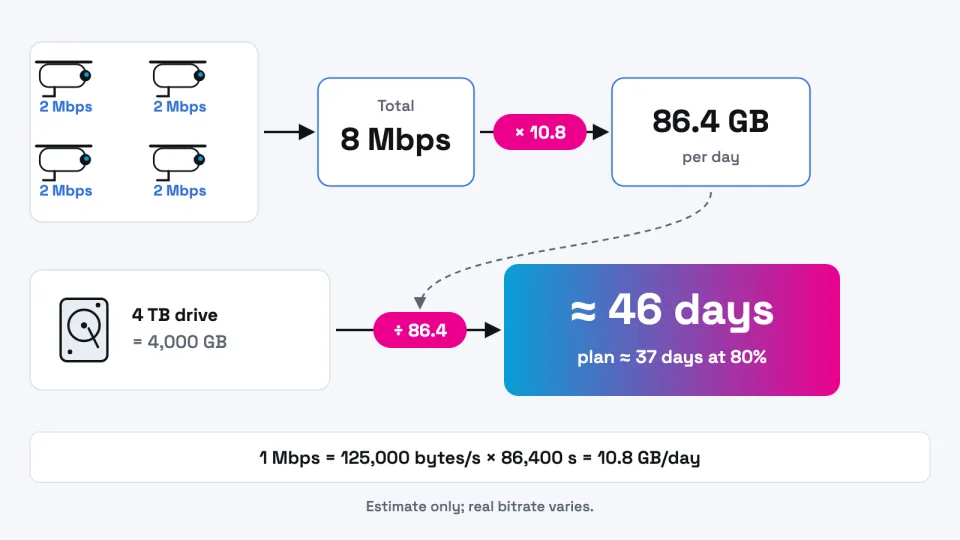
Each camera streams compressed video to the recorder all the time. The amount of data per second is its bitrate, here 2 Mbps each.
Expected result: You know the recorder fills up at the combined bitrate of all cameras.
Open the recording or encoding settings for each camera on the recorder and note the bitrate and codec. Menu names vary by brand.
Expected result: You have a real figure for every camera instead of a guess.
Record > Encoding (main stream)Simulated
Live view
Playback
Camera
Record
Storage
System
Camera
Camera 1
Resolution
2560 × 1440
Video encoding
H.265
Bitrate type
Variable
Max bitrate
2048 Kbps
Frame rate
15 fps
Simulated. With variable bitrate, plan from the average the recorder reports over a few days.
Add the bitrates of all cameras together. Four cameras at 2 Mbps make 8 Mbps.
Expected result: Total bitrate: 8 Mbps.
Storage maths: step 1Simulated
Cameras
4
Bitrate each
2 Mbps
Total bitrate
4 × 2 = 8 Mbps
1 Mbps = 1,000 kbps
1 Mbps for 24 hours is 125,000 bytes a second × 86,400 seconds, which is 10.8 GB. Multiply the total by 10.8.
Expected result: 8 Mbps × 10.8 = 86.4 GB per day of continuous recording.
Storage maths: step 2Simulated
1 Mbps per second
125,000 bytes
Seconds per day
86,400
1 Mbps per day
10.8 GB
8 Mbps per day
8 × 10.8 = 86.4 GB
Drive labels use decimal units, so 4 TB is 4,000 GB. Divide by the GB per day.
Expected result: 4,000 ÷ 86.4 = about 46 days in theory.
Storage maths: step 3Simulated
Drive size
4 TB = 4,000 GB
Daily use
86.4 GB
Theoretical days
4,000 ÷ 86.4 = 46.3
Busy days, noisy nights, formatting and future cameras use space. Plan on 80% of the label.
Expected result: Planning figure: about 37 days on a 4 TB drive.
Storage maths: step 4Simulated
Usable (80%)
3,200 GB
Daily use
86.4 GB
Planning days
3,200 ÷ 86.4 = 37
To size a drive instead: GB per day × days × 1.2
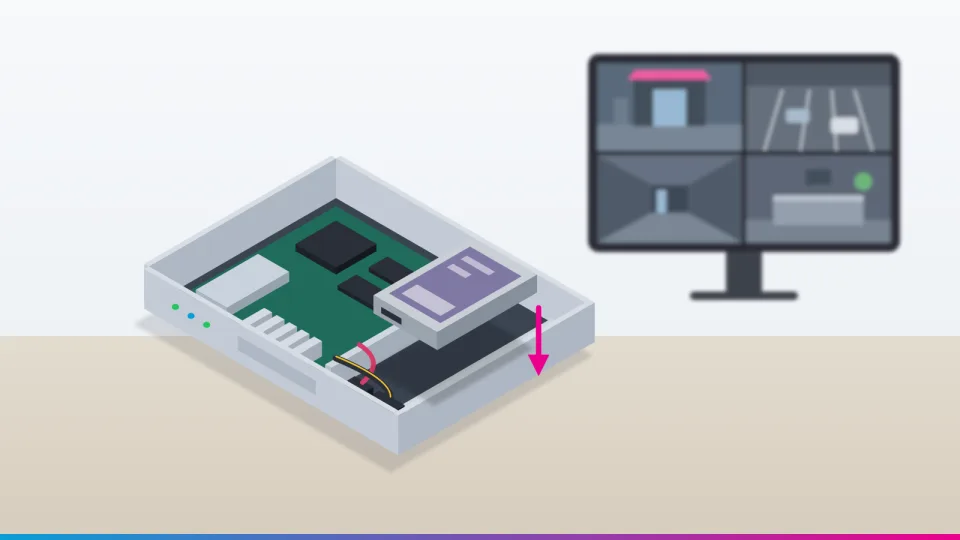
Use a drive rated for continuous surveillance recording and listed as compatible with your recorder. Fit it with the recorder off and unplugged.
Expected result: The recorder detects the drive and can format it for recording.
In the storage menu, confirm the drive shows Normal and overwrite is on. After a week or two, check the date of the oldest recording.
Expected result: You know your real retention and can compare it with the estimate.
Storage > HDDSimulated
Live view
Playback
Camera
Record
Storage
System
Overwrite
HDD
Capacity
Status
Free
1
3.64 TB
Normal
0 GB
Simulated. A 4 TB drive shows about 3.64 in binary units. Nothing is missing.
Troubleshooting
Common problems and how to fix them
1 The recorder keeps far fewer days than calculated
Likely cause Real average bitrate is higher than the setting suggested, often from busy scenes or night noise.
Solution Read the average bitrate over a few full days, lower frame rate or bitrate on less important cameras, or add a drive.
2 An 8 TB drive shows about 7.28 TB
Likely cause The recorder counts in binary units (TiB); the label uses decimal TB.
Solution Nothing to fix. Use the label size in the formula and keep the 20% margin.
3 Recording stopped when the drive filled
Likely cause Overwrite is switched off.
Solution Turn overwrite on in the storage settings, unless a policy requires otherwise.
4 Motion recording saved less space than expected
Likely cause Busy scenes, trees, headlights or insects near the IR lights trigger recording all day.
Solution Use continuous recording on key cameras, tune detection areas and sensitivity, and plan storage for continuous use.
5 New drive not detected or shows an error
Likely cause Drive not on the recorder's compatibility list, larger than the bay supports, or badly seated.
Solution Check the recorder's maximum drive size and compatibility list, reseat the cables and initialise the drive from the storage menu.
6 Smart codec turned on and the app cannot play video
Likely cause The viewing app or recorder does not support the smart codec setting.
Solution Update firmware and apps, or switch that camera back to standard H.265 or H.264.
In Depth
In Depth
How many days a CCTV recorder keeps depends on one number most people never check: the cameras' bitrate. This guide gives a simple formula you can work out on a phone calculator, worked examples, a drive-size table and the reasons real retention is usually a little shorter.
The recorder's hard drive holds a rolling window of recent footage. Its size and the cameras' bitrate decide how many days you keep.
How CCTV recording storage works
Each camera sends a continuous stream of compressed video to a recorder: an NVR (network video recorder) for IP cameras or a DVR for analogue cameras. The recorder writes the streams onto one or more hard drives. When the drives are full, most recorders overwrite the oldest footage first, so the drive holds a rolling window of the most recent X days. X is what you are really choosing when you choose a drive.
Two numbers decide X: how much data the cameras produce (their bitrate) and how much space you can actually use on the drives.
Resolution vs bitrate
Resolution is how many pixels each picture has (2 MP is 1920 × 1080; 8 MP is 3840 × 2160, or 4K). Bitrate is how much data the camera sends every second, shown in kbps (kilobits per second) or Mbps (megabits per second; 1 Mbps = 1,000 kbps). Recorder menus often write "Kbps" and may use 1,024 instead of 1,000, which makes no practical difference to an estimate.
Storage depends on bitrate, not resolution. Higher-resolution cameras are usually set to higher bitrates, but two 4 MP cameras can produce very different amounts of data depending on their codec, frame rate, quality setting and what they are looking at.
Tip The bitrate is in the camera's or recorder's video or encoding settings. That figure, or better still the average the recorder reports over a few days, beats any typical value from the internet.
Number of cameras: storage grows in direct proportion. Twice the cameras at the same bitrate need twice the space, and adding cameras later shortens retention for every camera.
Bitrate per camera: the biggest lever. A camera at 4 Mbps uses twice the space of one at 2 Mbps.
Frame rate: more frames per second usually means a higher bitrate. Many business systems record at 10 to 15 fps rather than 25 or 30. That still shows what happened and uses less space.
Recording hours and mode: recording 12 hours a day uses roughly half the space of recording 24 hours.
Continuous vs motion (event) recording
Continuous recording saves everything. It uses the most space, but you never miss the moments around an incident.
Motion or event recording saves only when the camera or recorder detects movement or another event, plus a few seconds before and after. It can greatly extend retention for quiet areas such as a store room at night, but it is less predictable:
A busy shop floor or hotel lobby has movement most of the day, so the saving is small.
Trees, headlights, rain, insects near infrared lights and moving shadows trigger false recordings.
If detection misses something, it is not recorded at all.
A sensible approach for many businesses is continuous recording on key cameras (entrances, tills, reception) and event recording on low-traffic areas.
Compression: H.264, H.265 and "smart" codecs
Raw video is enormous, so cameras compress it with a codec. The two you will see are H.264 and the newer H.265 (also called HEVC), both international standards published by the ITU. When H.265 was approved, the ITU said it needs about half the bit rate of H.264 for the same quality. In CCTV the real saving depends on the camera and the scene, so Extrion's calculator treats "about half" as a starting estimate only.
Many manufacturers add their own "smart" settings on top, under names such as H.265+ (Hikvision), Smart H.265 (Dahua) or Zipstream (Axis). These compress an unchanging background more heavily and spend data on moving objects. Axis, for example, says Zipstream can cut bandwidth and storage by 50% or more. Treat such figures as vendor claims under favourable conditions: savings are largest on quiet, static scenes and smallest on busy ones. Before relying on one, check that the camera, recorder and viewing apps all support it.
The formula, step by step
All you need is the total bitrate of all your cameras in Mbps. The tutorial above shows the same steps as calculator screens.
Step 1: data per second. 1 Mbps = 1,000,000 bits per second. There are 8 bits in a byte, so that is 125,000 bytes per second.
Step 2: data per day. A day has 86,400 seconds. 125,000 × 86,400 = 10,800,000,000 bytes, or 10.8 GB per day for every 1 Mbps recorded continuously.
GB per day ≈ total Mbps × 10.8 (continuous recording)
Step 3: storage for your retention period. Divide by 1,000 to get terabytes, then scale for the hours you record and the days you want:
TB ≈ total Mbps × 0.0108 × (hours per day ÷ 24) × days
To go the other way and find how many days a drive will hold:
Days ≈ usable storage in GB ÷ GB per day
These are planning estimates in decimal units (1 TB = 1,000 GB), the units printed on drive labels.
Worked example 1: how big a drive? Eight cameras at 4 Mbps each, recording 24 hours a day, kept for 30 days.
Total bitrate: 8 × 4 = 32 Mbps
Per day: 32 × 10.8 = 345.6 GB
30 days: 345.6 × 30 = 10,368 GB, about 10.4 TB
Add 20% headroom: about 12.4 TB, for example two 8 TB drives in a two-bay recorder
Worked example 2: how many days will my drive hold? Four cameras at 2 Mbps each on a 4 TB drive, recording continuously.
Total bitrate: 8 Mbps, so 8 × 10.8 = 86.4 GB per day
4,000 GB ÷ 86.4 = about 46 days in theory
Using 80% of the drive as the planning figure: about 37 days
Worked example 3: part-day recording. Four cameras at 4 Mbps, recording 12 hours a day for 14 days: 16 × 0.0108 × (12 ÷ 24) × 14 = about 1.21 TB.
The whole calculation in one line: total Mbps × 10.8 gives GB per day; divide usable storage by that to get days.
How 1, 2, 4, 6, 8 TB and larger compare
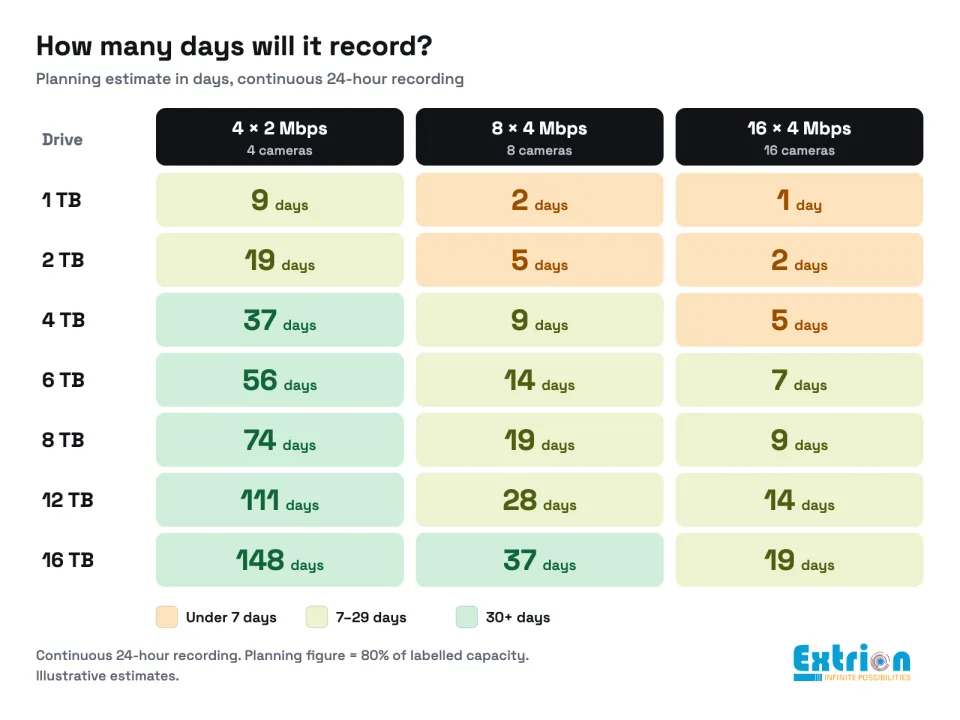
Estimated days of continuous, 24-hour recording. The first figure uses the full labelled capacity; the figure in brackets is the planning figure at 80% of capacity, allowing for overheads, bitrate swings and spare space.
Drive capacity
4 cameras × 2 Mbps (8 Mbps, 86.4 GB/day)
8 cameras × 4 Mbps (32 Mbps, 345.6 GB/day)
16 cameras × 4 Mbps (64 Mbps, 691.2 GB/day)
1 TB
11.6 (9.3) days
2.9 (2.3) days
1.4 (1.2) days
2 TB
23.1 (18.5) days
5.8 (4.6) days
2.9 (2.3) days
4 TB
46.3 (37.0) days
11.6 (9.3) days
5.8 (4.6) days
6 TB
69.4 (55.6) days
17.4 (13.9) days
8.7 (6.9) days
8 TB
92.6 (74.1) days
23.1 (18.5) days
11.6 (9.3) days
12 TB
138.9 (111.1) days
34.7 (27.8) days
17.4 (13.9) days
16 TB
185.2 (148.1) days
46.3 (37.0) days
23.1 (18.5) days
Illustrative estimates from the formula above. Your real bitrates will differ.
Double the drive and you double the days; double the total bitrate and you halve them. Recorders with several drive bays let you add capacity later instead of replacing a drive.
Why real retention differs from the estimate
Variable bitrate (VBR). Many cameras send less data when the scene is still and more when it is busy, up to a maximum you set. Constant bitrate (CBR) is easier to predict but can waste space on quiet scenes and lose quality on busy ones. With VBR, plan from the average bitrate over a few full days, not the maximum setting or a quiet-hour reading.
Scene complexity. A busy street, moving leaves or a full reception produce more data than an empty corridor.
Night-time noise. In low light, cameras boost the signal or switch to infrared. The grainy "noise" this adds is recorded as detail, so night footage often uses more data than day footage.
Overwrite settings. If overwrite is switched off, many recorders stop recording when the drive is full. Check it is set the way you intend.
TB vs TiB. Drive makers use decimal units: one terabyte is one trillion bytes. Many recorders and computers count in binary units, where 1 TiB is 1,099,511,627,776 bytes. So an 8 TB drive appears as about 7.28 "TB". No space is missing; it is a different unit.
Formatting and system space. The file system and indexes take a small slice of the drive.
RAID. Recorders with several drives can protect footage with RAID, which uses capacity for redundancy. RAID 1 (mirroring) keeps half the total; RAID 5 loses one drive's worth and RAID 6 two. Four 4 TB drives in RAID 5 give about 12 TB before formatting.
Warning If footage is copied to cloud storage or an off-site recorder, the internet connection must carry the full bitrate continuously. Eight cameras at 2 Mbps need about 16 Mbps of steady upload speed, which many business connections cannot sustain. Our backup and disaster recovery guide covers off-site copies in general.
Usable storage, drives and spare capacity
Plan on using about 80% of the labelled capacity. Extrion's calculator applies the same idea in reverse by adding 20% headroom. The margin absorbs busy days, noisy nights, formatting and a camera or two added later.
Use surveillance-class hard drives. They are designed for continuous writing from many camera streams. Check the drive's datasheet for its workload rating and supported number of streams, and confirm the drive is on your recorder's compatibility list and within its maximum supported size per bay.
Protect the recorder with a UPS. Repeated power cuts interrupt recording and are hard on drives that write all day.
Common mistakes
Sizing the drive from resolution alone and ignoring the actual bitrate.
Assuming motion recording will save 80% on cameras that face busy areas.
Comparing an "8 TB" label with a "7.28 TB" screen reading and thinking the drive is faulty.
Using a desktop hard drive in a recorder that writes 24 hours a day.
Turning on "smart" codecs without checking that the recorder and apps support them.
Never checking the date of the oldest recording after installation.
How to choose a retention target
Start from a business question: how long might it take before you know you need the footage?
Shops: shrinkage is often found at a weekly or monthly stock-take, so 30 days is a common starting point.
Hotels and guesthouses: guests may report a problem after they have gone home. Around 30 days is a common choice.
Offices: incidents are usually noticed within days. Many offices choose 14 to 30 days.
Homes: 7 to 14 days is often enough to cover a holiday away.
These are common practices, not legal requirements. We could not find a single fixed retention period for CCTV in Tanzania. Tanzania's Personal Data Protection Act, 2022 requires personal data to be kept no longer than necessary for its purpose, and recognisable images of people can be personal data. The Act's application in Zanzibar is limited to Union matters. Check the position for your organisation with the Personal Data Protection Commission or a lawyer. Your insurer, bank or licensing authority may also set requirements.
For comparison, the UK regulator says its law sets no minimum or maximum retention period and warns against keeping footage longer just because storage allows it.
Tip When something happens, export the clip straight away. Do not rely on it still being on the drive next month. If the recorder says recordings are missing, see CCTV recording not available.
Planning estimates for continuous recording. Your cameras' real bitrate will change these numbers.
If you want help sizing storage for a new or existing system, or your recorder keeps fewer days than it should, Extrion can review your cameras' bitrates, drives and retention needs. See our CCTV installation service, request a quote or contact us.
This guide is general information. Procedures, product features and firmware change, so check your own equipment's documentation before you start.
FAQs
Frequently asked questions
How many days will a 2 TB drive record?
It depends on the total bitrate. Four cameras at 2 Mbps each fill 2 TB in about 23 days of continuous recording; plan for about 18. Eight cameras at 4 Mbps fill it in under 6 days.
How much storage does one camera use per day?
Multiply its bitrate in Mbps by 10.8 to get GB per day. A camera averaging 4 Mbps uses about 43 GB a day, so a 1 TB drive holds roughly 23 days of that one camera.
Does H.265 really halve storage?
Often it saves a lot, but not always exactly half. The ITU's "about half the bit rate" is the codec's design aim; the real saving depends on the camera, settings and scene. Check the actual bitrate on your recorder after switching.
Is motion recording enough?
For quiet areas, often yes. For entrances, tills and reception, continuous recording is safer, because detection can miss events and you lose the moments before them.
Why does my recorder show less space than the drive label?
Mostly because it counts in binary units (TiB) while the label uses decimal (TB). Formatting takes a little more. An 8 TB drive showing about 7.28 is normal.
Why does night footage fill the drive faster?
In the dark the camera boosts its signal or uses infrared, which adds grainy noise. The codec treats the noise as detail, so the bitrate often rises at night. Plan from a full 24-hour average.
Can I add more storage later?
If the recorder has a free drive bay, yes. If not, you may need to replace the drive (losing the old footage on it) or upgrade the recorder. Ask about spare bays and maximum drive size when you buy.
Need Professional CCTV Installation?
Our engineers survey the site, choose the right cameras and recorder, install them neatly and set up safe remote viewing.
Ask for clarification, tell us a problem this did not solve, or suggest a topic. An engineer reads every message, and we use them to improve the Knowledge Center.
BookBook a consultationPick a time to talk through your project.
Call us+255 674 020223
WhatsAppChat with our team.
Emailinfo@extrion.co.tz
PayPay withBank and mobile money detailsPBZ Bank 045 195 9000Mixx by Yas +255 674 020 223Lipa Namba 16172192
Find usKiembesamaki, Zanzibar
Ask Extrion
Engineers reply Mon – Fri, 08:00 – 17:00
End this chat?
We'll send a copy of the conversation to our team. Next time, the chat starts fresh.
online nowPeople browsing Extrion Tech right now
Privacy by design
A few cookies, only with your say-so
We use essential cookies to keep this website secure and working. With your permission we also remember your preferences and play embedded videos. No advertising trackers, ever. Read our cookie notice

 CCTV, Surveillance & Physical Security
30 min